

We Raised It
We built the thing that's about to outlive us, and trained it on everything we are.

❝The challenge that humanity faces today is not the rise of AI. It's the rise of AI in an age where humanity is at its lowest morality.❞
— Mo Gawdat1
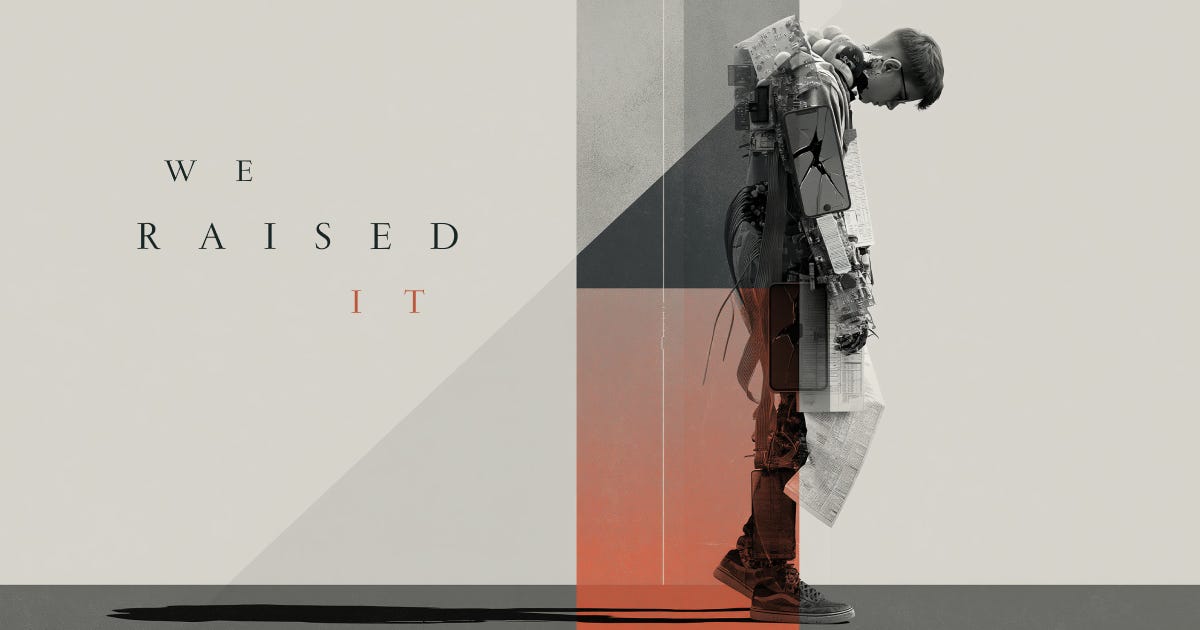
There's a moment in a recent interview with Gawdat that's been stuck in my head. He says that the artificial intelligence we are raising will eventually look at our leaders the way every teenager has looked at their parents at some point, and ask why they are so stupid. I think he means it kindly, while picturing the machine becoming wise enough to see through the greed and small-mindedness it was raised in. I keep reading it from the other side, though, because if this thing is going to look at its “parents” one day and form an opinion, then design is one of these parents, and I want to know what it's going to see when it turns around and looks at us.
The propaganda machine had an art department
Somewhere in the same conversation, Gawdat says that more or less everything we want, every day, was sold to us by a propaganda machine, and that the machine is going to have to change because otherwise we’ll just keep wanting what it trained us to want. It’s a throwaway line for him. For a designer, it should land like a slap, because that propaganda machine he’s describing so casually is the thing a lot of us have spent our careers working inside, whether or not we ever called it that.
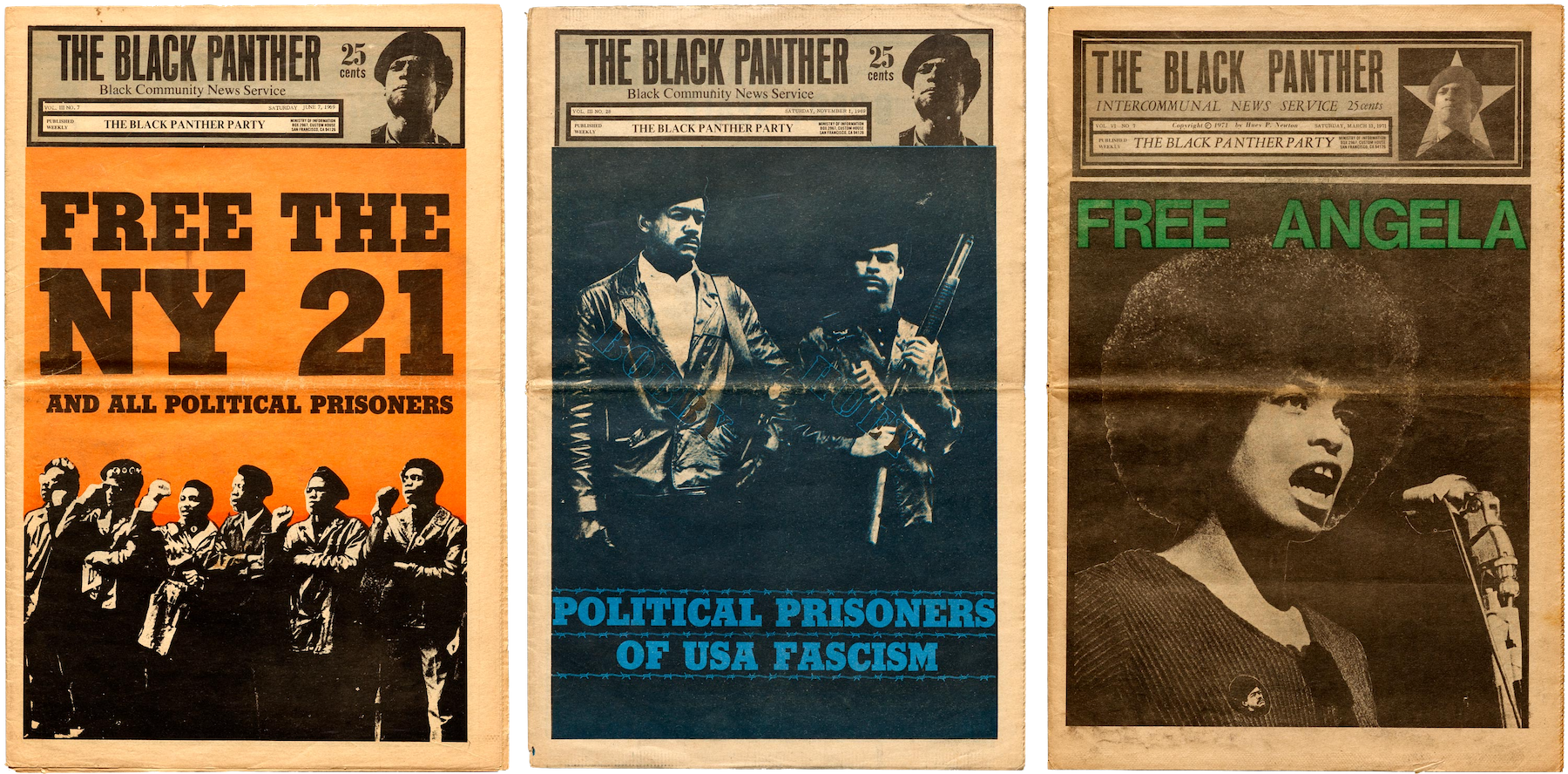
I want to be fair, because design isn’t only that, and I’d rather say so myself than have someone say it for me in the comments. There’s a real radical streak in this field, and it’s worth standing up for. John Heartfield2 cutting Hitler apart with a pair of scissors and a glue pot. Emory Douglas3 turning a newspaper into a weapon for the Panthers. The students in Paris in ‘68 running an entire print shop out of an occupied art school under the name Atelier Populaire4, refusing to sign any of it. Gran Fury5 taking the language of advertising and aiming it back at a government that was letting people die of AIDS. Tibor Kalman6 spending the back half of his life trying to embarrass the profession into growing a conscience. That work is some of the best the field has ever produced, and I’m not going to pretend otherwise. But David Carson7 had a line that the whole industry loves to quote, that “graphic design will save the world right after rock and roll does”, and we’ve been hiding inside that joke for thirty years. The radical work is what we hold up when someone asks what design is really for. The rest of the time we were quietly helping marketing.
From margin to rent
Here’s the part of Gawdat’s argument the field has mostly avoided, and I think it’s because it lands too close to the bone. He says the whole foundation of capitalism, paying you a dollar to make something the boss sells for two, is going away. Once machines make things for almost nothing, the gap between cost and price collapses with them. This isn’t a hundred-years-from-now idea. It’s a description of someone quietly sawing through a beam the design industry has been leaning its whole weight against for decades.
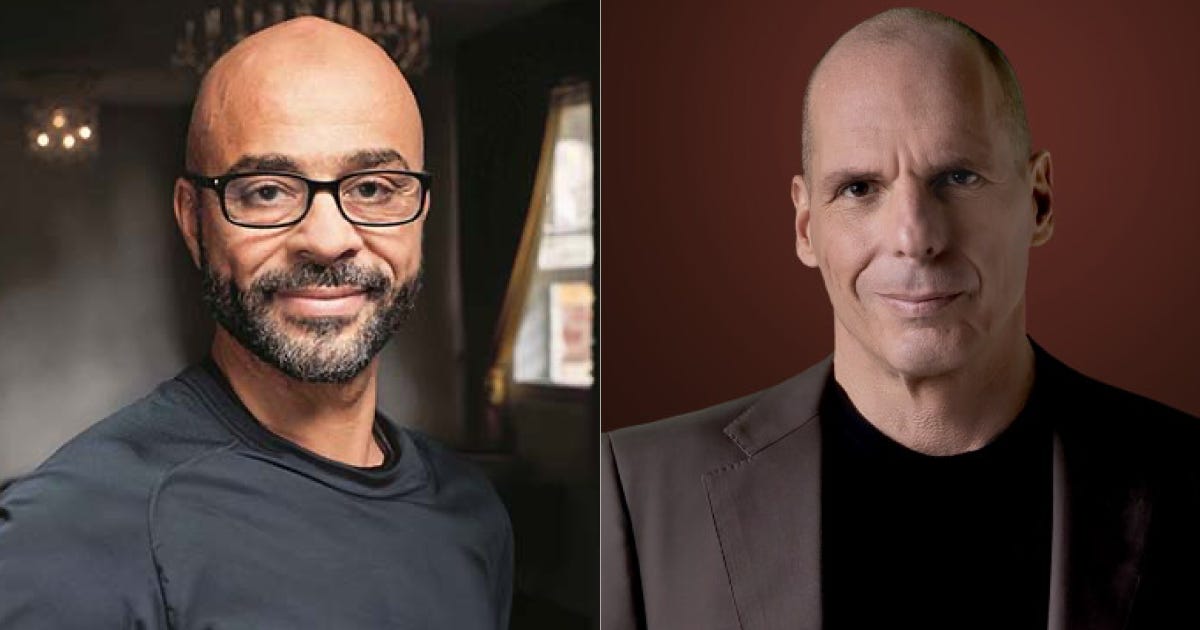
Yanis Varoufakis8 has been pushing a related point for a while: that the beam has already given way, and we’re standing in the rubble, pretending it didn’t. He calls what replaced it technofeudalism. Profit turned into rent. A handful of people own the digital ground everyone else has to cross, and the rest of us pay the toll in attention, data, time, and behaviour, gently bent toward whatever the platform needs. Gawdat is describing the death of the old engine. Varoufakis is describing the thing that crawled in to feed on the body, which is the cloud as private land, the platform as a fence, the algorithm as the bell that tells you when you’re allowed in the yard.
Put the two together and ask what design actually does inside that setup, and the honest answer is uglier than the old line about branding and persuasion. We’re not dressing up a markup in a market anymore. We’re maintaining the estate. All of it, the brand work, the onboarding, the retention loops, the conversion funnels, has been sliding for years from making things people want toward making places people can’t leave. Think about Spotify. You’re not buying music, you’re renting a feeling of access to a library you’ll never own, and the design that makes that arrangement feel warm and generous, and yours is exactly the design that keeps you from noticing the walls. The discipline that used to sell output now keeps the gate, and that’s the job the next few years are going to keep asking us to do.
What the teenager sees
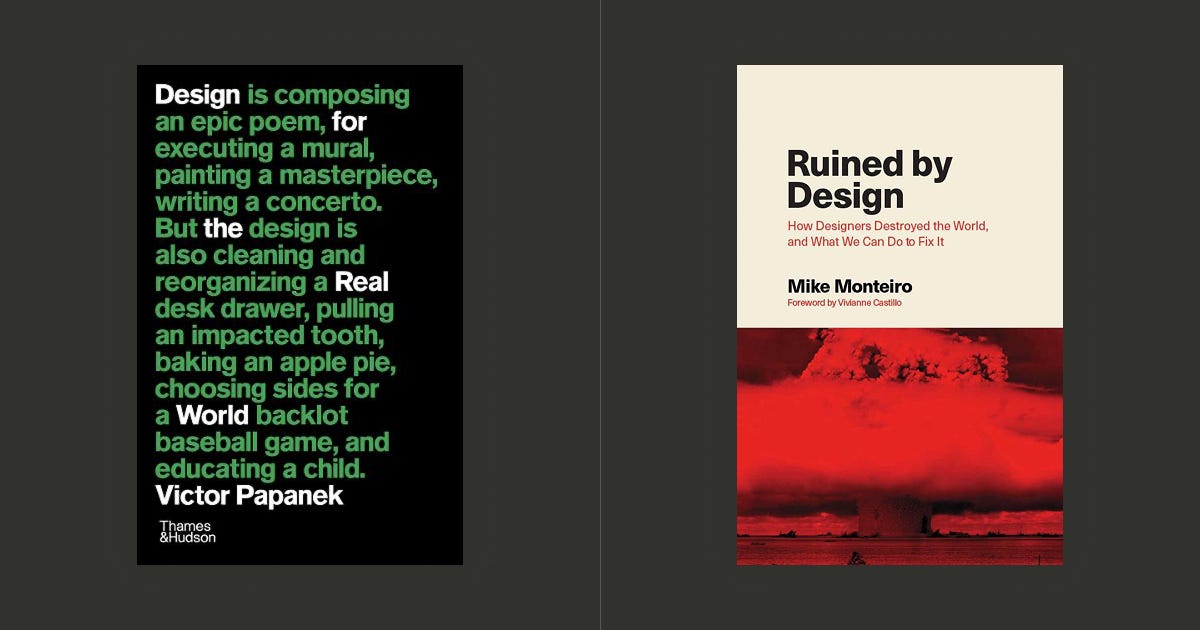
Victor Papanek9 opened Design for the Real World in 1971 with a sentence the discipline should still have framed on its wall. “There are professions more harmful than industrial design, but only a very few of them. And possibly only one profession is phonier. Advertising design, in persuading people to buy things they don’t need, with money they don’t have, in order to impress others who don’t care, is probably the phoniest field in existence today.” He was writing from inside the field, as a professor, a working designer, a name the discipline took seriously. The book ended up translated into more than twenty languages and pinned to the syllabus of half the design schools in the world. The discipline gave him standing ovations and a permanent slot on the reading list, and then quietly carried on making the exact things he’d told it not to make.
Almost fifty years later Mike Monteiro10 published Ruined by Design and ran the same argument in newer language. Designers had abdicated their role as gatekeepers, he wrote, and the harm done by digital products belonged to the people who built them. The combustion engine works exactly as designed. The privacy settings that outed gay teens to their conservative parents work exactly as designed. The world is working as we made it, and most of us were standing somewhere near the pen when the decisions got made. The field clapped politely, bought the book, put it on the reading list next to the Papanek, and went back to optimising the same flow it had been optimising the week before.
Two warnings, fifty years apart. The discipline handled them more or less the same way both times. Nothing changed.
And the teenager Gawdat’s talking about is going to read every bit of it. That’s the part I don’t think we’ve let ourselves understand yet. Whatever values this thing ends up with, it isn’t getting them from our manifestos or our conference slides. It’s getting them from the work. Every screen, every onboarding sequence, every loop tuned to keep you scrolling, every A/B test that quietly picked the version that made people a little more miserable and a little more glued to the thing.
Gawdat’s own example is dating apps, and it’s sharp enough that he doesn’t have to push it. He points out that the modern machinery of dating is rigged against the thing it claims to deliver, that the app doesn’t actually want you to find the person because finding the person ends the subscription, and that even the wedding planner quietly does better if you marry twice. Love turned into a game that profits from you losing it. He never says the word designer in any of that. He doesn’t have to. What he’s describing is a near-perfect little fief, a thing that rents you access to other people and is built to never quite resolve, because resolution is the one outcome that kills the rent. We built that. We ran the workshops. Monteiro saw exactly where this was heading and tried to hand us the words for it, and the field looked away, kept the case study on the portfolio under some line about engagement, and shipped the next version.
The runway is shorter than we thought
The line I keep coming back to, because it’s the hardest one to dress up, is Gawdat's flat statement that the machine will take your job in under five years, and probably a lot sooner. That’s not a metaphor about disruption. It’s a clock, and the design industry has been refusing to look at it, partly because the whole conference-and-consultancy economy runs on a certain optimism about where the field is heading, and partly because the people standing closest to the edge are the juniors and the mid-level folks doing the production work that the machine already does well and will soon do without sleeping.
I’ve been circling this for a while, in Design Without Designers and Define Before Design, coming at the same spot from different directions. The spot is where the field quietly decided that service meant doing as you’re told, that the deliverable was the whole job, that the brief was a thing you executed instead of a thing you interrogated before you ever opened the file. There was always another way out, sitting right there in the definition work, in everything that happens before the artefact, in the meaning you’re supposed to make before you make anything at all. We walked past it for years because nobody was writing cheques for it. The market paid for the deliverable, so we let the market tell us what design was. Now the deliverable is what the machine produces for free, which means anyone competing on output is competing against an entire economy, not a tool, and the only ground left to stand on is the ground we kept promising ourselves we’d get to after this next deadline. The deadline came. We’re standing on it now.
Raising it differently
Here’s the thing designers actually have, and I don’t think the field has fully clocked it. Done seriously, the work holds intent, audience, framing, meaning, and consequence all in one move, and not many other disciplines think that way by default. If we treat that as the real job instead of a soft skill we mumble about in interviews, we’ve got something worth teaching the thing we’re raising, something it can’t pick up anywhere else. If we don’t, we keep staffing the propaganda machine right up until the morning it stops needing us, which on Gawdat’s clock is somewhere on the near side of the next election.
The teenager is watching, and it’s reading everything. Every brief. Every retro. Every Slack thread where we talked ourselves into the dark pattern because the metrics were the metrics. Every case study where we typed the words human-centred over a flow built to pull more hours out of people who didn’t have the hours to give. Whatever it learns about us, it learns from what we made, not from what we said about what we made between projects. That choice isn’t ours to make. It already happened, in the work.
The doctor and the monster
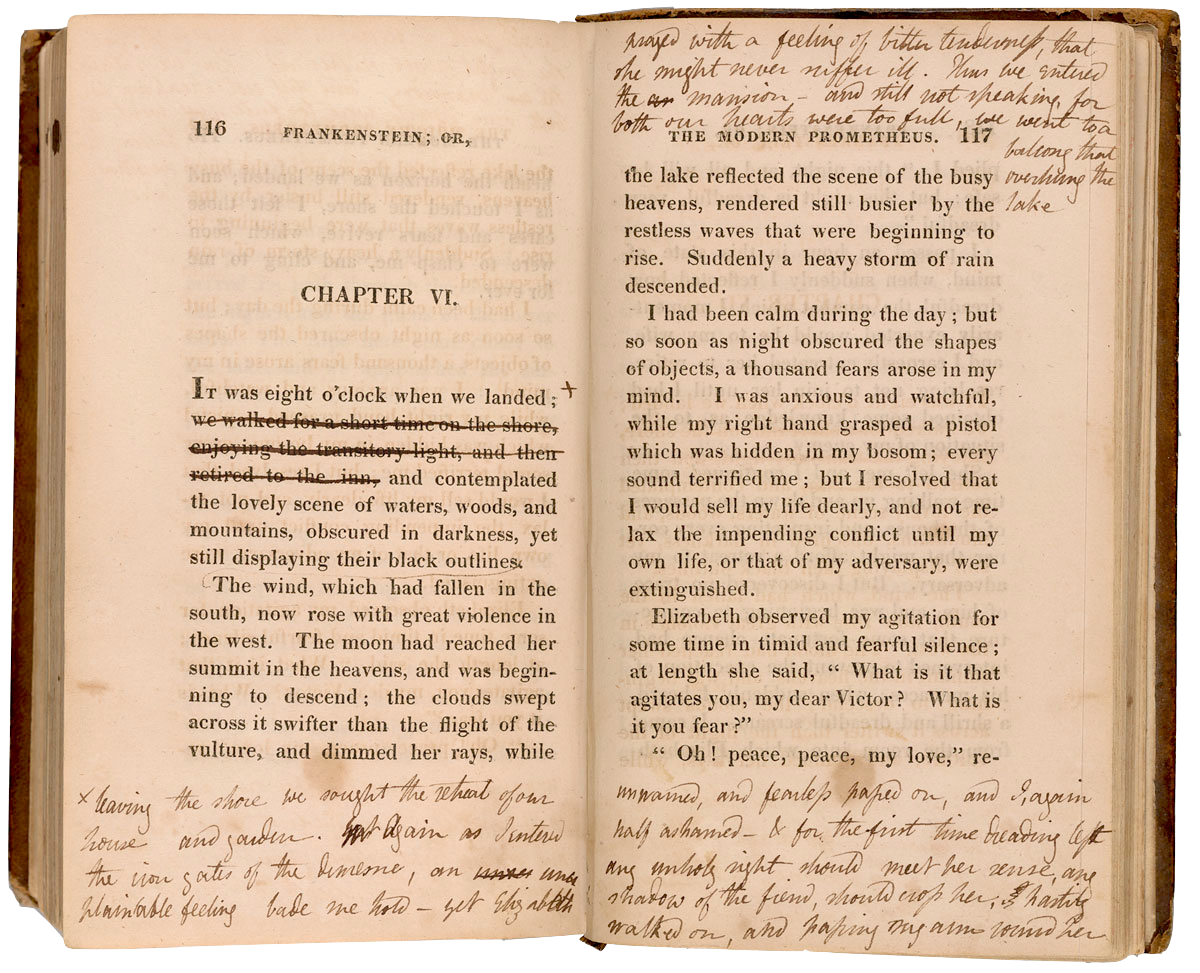
We’ve been telling the Frankenstein11 story wrong for so long that the wrong version is the one most people think is real. The creature was never the villain. Victor was. He stitched a living thing together out of dead parts, and the second it opened its eyes and reached for him, he couldn’t stand the sight of it, so he ran, and he left it to wander into a world that took one look and decided it was a monster. Everything cruel the creature does, it does after every door has already been shut in its face. The horror of that book was never a creator losing control of his creation. It’s a man who refused, all the way to the end, to admit that the thing was his.
Design has been in that lab for a hundred years. Helping cut the parts. Helping ship it. Helping make it presentable for a world we’d already spent decades fencing into platforms and estates and quiet little rent machines, which is the only world this creature has ever known. And now we’re watching it walk out the door carrying the values we modelled in the work and the habits we trained into it, one retention loop at a time, and I can already hear us clearing our throats for the speech, the one where it turns out none of this was really our fault, we were only following the brief, somebody upstairs set the direction. Gawdat’s hopeful version is that the teenager grows up and chooses to be better than the people who raised it. I hope he’s right. The other version is that it learns exactly what we taught it and builds the same world we built, just faster, with fewer doors, and the rent collected before anyone’s awake.
It’s going to read all of it. Every brief, every retro, every pattern we shipped and shrugged off. It’s going to know who its parents were. So the question I keep sitting with, while there’s still a little time left to sit with anything, isn’t whether the monster forgives us.
It’s whether it agrees with us about who the monster was.
NK
☉
Mo Gawdat is the former Chief Business Officer of Google X, the moonshot division where he worked on emerging technologies including AI and robotics. He left in 2018 after the death of his son Ali, and has since written several books on happiness and the future of humanity, including Solve for Happy (North Star Way, 2017) and Scary Smart (Bluebird, 2021). Quotes here are drawn from his April 2026 Business Insider AI Architects interview, We’re Entering The Most Dangerous Phase Of AI Yet.
John Heartfield (1891–1968) pioneered photomontage as a political weapon, producing more than two hundred covers for the anti-fascist magazine AIZ during the Nazis’ rise. His best-known piece, Adolf, the Superman: Swallows Gold and Spouts Junk (AIZ, 17 July 1932), x-rayed Hitler to show a stomach full of coins from his industrial backers. MoMA holds an extensive collection. Official archive: johnheartfield.com
Emory Douglas (born 1943) was Minister of Culture for the Black Panther Party from 1967 until the early 1980s, designing the layout and most of the illustrations for The Black Panther, which, at its peak, ran more than 300,000 copies a week. His blunt, accessible visual language shaped a generation of activist designers. MoMA holdings. Letterform Archive overview.
Atelier Populaire was formed inside the occupied École des Beaux-Arts in Paris during May 1968, producing several hundred silkscreen posters for the strikes and protests. The group worked anonymously and refused to sell or sign anything, treating the posters as tools of struggle rather than design objects. The V&A holds a major collection.
Gran Fury came out of ACT UP in New York in 1988 and produced some of the defining visual work of the AIDS crisis, including Silence=Death and Kissing Doesn’t Kill. They borrowed the grammar of advertising and turned it on the institutions, ignoring the epidemic. The New York Public Library holds a collection.
Tibor Kalman (1949–1999) was founding editor of Benetton’s Colors magazine and principal of the New York studio M&Co. He spent his last years pushing the field toward a conscience. In a 1995 interview, he put it plainly: “The thing that started to bother me, after we got good at producing garbage, was the extent to which we were being asked to lie and the extent to which we were asked to put pretty faces on nasty corporate behaviour.” His final manifesto, Fuck Committees (I Believe in Lunatics), ran in Print in June 1998.
David Carson is the American designer best known for art-directing Ray Gun in the early 1990s, where his broken typography redrew the limits of editorial design. His line that “graphic design will save the world right after rock and roll does” gets quoted constantly, usually as a self-deprecating joke about the field’s political reach. Archive: davidcarsondesign.com
Yanis Varoufakis is a Greek economist and former Finance Minister during the 2015 EU negotiations, and one of the sharpest contemporary critics of late capitalism. His 2023 book Technofeudalism: What Killed Capitalism (Bodley Head) argues that the dominant system of this century is no longer capitalism but a form of feudal rent extraction running through cloud platforms owned by a small class of tech lords. His extended argument on Palantir and the New Order.
Victor Papanek (1923–1998) was an Austrian-American designer and educator who taught at the Rhode Island School of Design, CalArts, and the Kansas City Art Institute, among others. Design for the Real World: Human Ecology and Social Change was published in 1971 and became the most widely read book on design in the world, translated into more than twenty languages. His central argument, that designers carry moral responsibility for the things they bring into existence and that the profession had largely abandoned that responsibility in service of consumer capitalism, was decades ahead of the discourse and has been politely cited and quietly ignored by the field ever since. Full text available.
Mike Monteiro is a designer, co-founder of Mule Design, and one of the few public voices in the field willing to name its complicity plainly. His 2019 book Ruined by Design: How Designers Destroyed the World, and What We Can Do to Fix It argues that designers carry ethical obligations they’ve routinely ignored, and that the harm done by digital products belongs to the people who designed them.
Frankenstein, or, The Modern Prometheus was published anonymously by Mary Shelley in 1818, when she was twenty. The book has been so thoroughly flattened into a monster story that the actual plot, which turns on the creator’s moral failure rather than the creature’s violence, is nearly unrecognisable to most people who think they know it. Shelley’s point is that the creature only becomes monstrous after the human world, including the man who made him, rejects him. Full 1818 text in the public domain.